
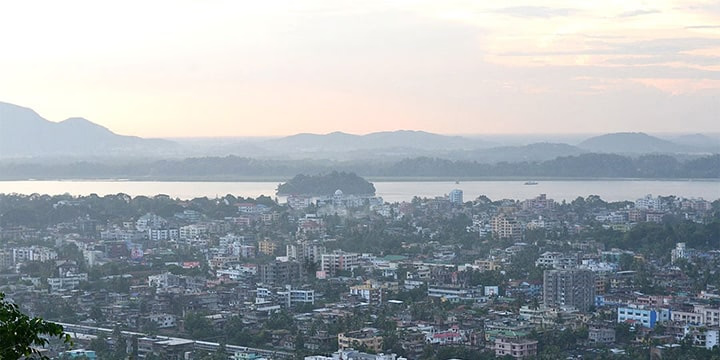
Guwahati, the largest city in the Indian state of Assam, sits along the mighty Brahmaputra River and serves as the main gateway to India’s northeastern region. Surrounded by rolling hills, forests and tea plantations, the city is both a cultural centre and a strategic aviation hub linking the eastern Himalayas with the rest of India.
For travellers visiting Bhutan, Guwahati is one of the most convenient transit points. With its well-connected airport and proximity to Bhutan’s southern border, the city provides both air and land access to the Himalayan kingdom.
Often referred to as the gateway to Northeast India, Guwahati is one of the region’s most important commercial and cultural centres. The city blends modern urban life with deep spiritual traditions, reflecting Assam’s rich history and diverse communities.
One of Guwahati’s most famous landmarks is the Kamakhya Temple, a revered Hindu pilgrimage site located on Nilachal Hill overlooking the Brahmaputra River. The temple attracts devotees from across India and is considered one of the most sacred shrines dedicated to the goddess Shakti.
Beyond its religious significance, Guwahati also serves as a starting point for travellers exploring the natural landscapes of Assam, including national parks, river islands and wildlife reserves.
Lokpriya Gopinath Bordoloi International Airport (GAU) serves as the main airport for Assam and the wider northeastern region of India. Located approximately 25 kilometres from Guwahati city centre, the airport connects the region with major Indian cities and several international destinations.
The airport has expanded significantly in recent years and now handles millions of passengers annually. Modern facilities provide travellers with comfortable departure and arrival experiences.
Airport amenities include check-in counters, immigration services for international flights, duty-free shops, restaurants and cafés, passenger lounges and efficient baggage handling services.
Because of its strategic location near Bhutan, the airport is frequently used by travellers heading to the Himalayan kingdom.
Guwahati offers convenient flight connections to Paro International Airport, Bhutan’s only international airport.
Drukair – Royal Bhutan Airlines operates flights between Guwahati (GAU) and Paro (PBH). These flights are relatively short, with a typical duration of about one hour, making Guwahati one of the closest aviation gateways to Bhutan.
The route is commonly used by travellers exploring both northeastern India and Bhutan in a single journey.
Although the flight from Guwahati to Bhutan is brief, the journey offers beautiful aerial views as the aircraft approaches the Himalayas.
Departing from the wide plains of the Brahmaputra Valley, the landscape gradually rises into the forested foothills of the eastern Himalayas. The final approach into Paro Airport is particularly remarkable, as the aircraft carefully navigates through steep mountain valleys before landing in the picturesque Paro Valley.
This landing experience is widely regarded as one of the most unique and scenic in the world.
Because of its close proximity to Bhutan and its strong aviation connections, Guwahati has become an important gateway for travellers visiting the kingdom. Many visitors combine their Bhutan trip with explorations of Assam’s tea estates, wildlife sanctuaries and river landscapes.
From the lively banks of the Brahmaputra River to the serene mountain valleys of Bhutan, the journey offers a fascinating contrast between two regions shaped by the natural beauty of the eastern Himalayas.
Are you dreaming of a journey that gently unravels the tapestry of Bhutan’s living heritage over ten soul-enriching days? Our 10‑Day Discover Bhutan Cultural Tour is a carefully...
Read moreThis luxury Bhutan itinerary is a preliminary draft, thoughtfully crafted to inspire your journey through the Land of the Thunder Dragon. However, every traveller is unique—and so...
Read moreHave you ever longed to step into a land where tradition reigns supreme, the air is steeped in prayer flags and ancient melodies, and every mountain pass feels like walking through...
Read more